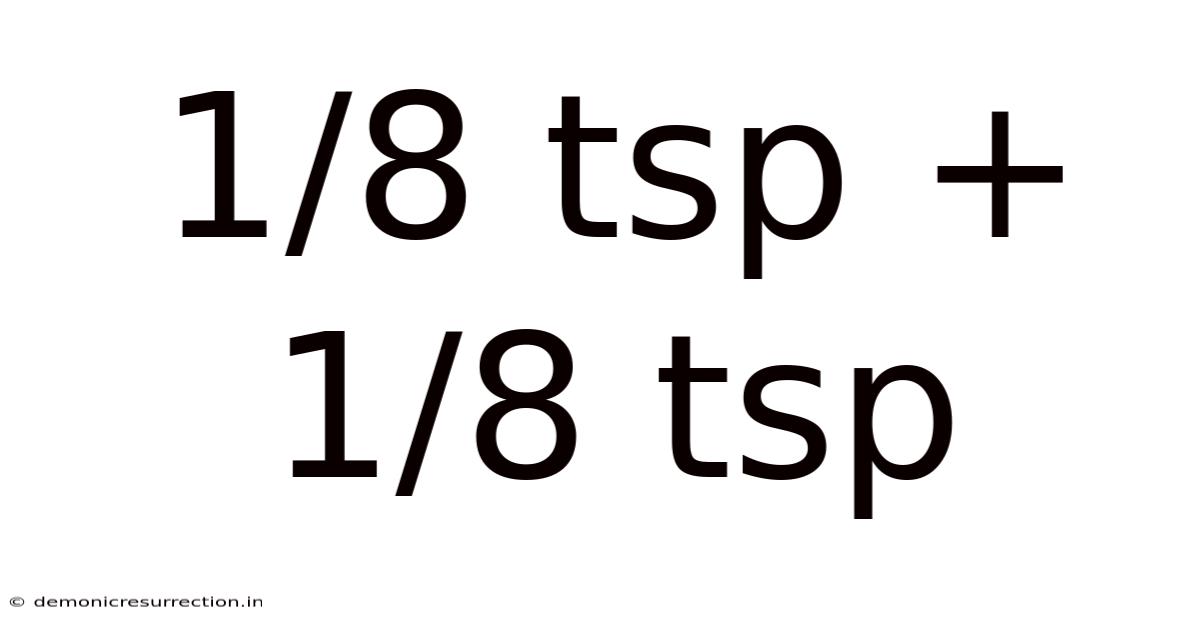
Decoding the Mystery: 1/8 tsp + 1/8 tsp = ? A Deep Dive into Fractions and Culinary Precision
This seemingly simple question, "1/8 tsp + 1/8 tsp = ?Worth adding: this article will look at the mathematics behind adding fractions, exploring practical examples, and addressing common misconceptions. While the answer might seem obvious at first glance, understanding the underlying principles is crucial for various applications, from baking and cooking to scientific measurements and everyday problem-solving. ", often hides a surprising depth for those unfamiliar with fraction addition. We'll also examine the importance of precise measurements, especially in sensitive contexts like culinary arts and pharmaceuticals.
Understanding Fractions: The Building Blocks
Before tackling the addition, let's refresh our understanding of fractions. It consists of two numbers: the numerator (the top number) and the denominator (the bottom number). A fraction represents a part of a whole. The denominator indicates how many equal parts the whole is divided into, and the numerator indicates how many of those parts are being considered But it adds up..
Some disagree here. Fair enough.
In our case, we have 1/8 tsp. This means one part out of eight equal parts of a teaspoon. The denominator (8) tells us the teaspoon is divided into eight equal parts, and the numerator (1) tells us we're dealing with only one of those parts And that's really what it comes down to..
Adding Fractions: A Step-by-Step Guide
Adding fractions with the same denominator is straightforward. We simply add the numerators and keep the denominator the same. Let's apply this to our problem:
1/8 tsp + 1/8 tsp = (1 + 1)/8 tsp = 2/8 tsp
So, 1/8 tsp + 1/8 tsp equals 2/8 tsp Not complicated — just consistent..
Simplifying Fractions: Reducing to the Lowest Terms
While 2/8 tsp is a correct answer, it's not in its simplest form. In real terms, simplifying a fraction means reducing it to its lowest terms by dividing both the numerator and the denominator by their greatest common divisor (GCD). In this case, the GCD of 2 and 8 is 2 And that's really what it comes down to..
Dividing both the numerator and denominator by 2, we get:
2/8 tsp = (2 ÷ 2) / (8 ÷ 2) tsp = 1/4 tsp
Which means, the simplified answer is 1/4 tsp.
The Significance of Precision in Measurement
The seemingly small difference between 2/8 tsp and 1/4 tsp highlights the importance of accuracy in measurement, particularly in fields like baking and cooking. Take this case: a recipe calling for a specific amount of baking powder might not rise properly if the amount is off by even a small fraction. So naturally, while the difference might seem negligible in some recipes, in others, it can significantly impact the final outcome. Similarly, in pharmaceutical applications, precise measurements are crucial for ensuring the correct dosage and preventing potential adverse effects Simple, but easy to overlook..
In baking, the leavening agents (baking powder, baking soda) are particularly sensitive to precise measurements. A slight excess can result in a dense cake, while a slight deficiency can lead to a flat one. Similarly, the delicate balance of flavors in many recipes relies heavily on precise measurements of ingredients.
Practical Applications Beyond the Kitchen
The ability to add fractions accurately extends far beyond the realm of cooking. Consider the following scenarios:
- Construction and Engineering: Precise measurements are critical in construction and engineering projects. Errors in fractions of an inch can lead to significant structural problems.
- Science and Research: Scientists routinely use fractions in their measurements and calculations. Accuracy is vital for the reproducibility and validity of research findings.
- Finance and Accounting: Fractions are used extensively in financial calculations, including interest rates, stock prices, and profit margins.
- Everyday Life: We encounter fractions in our daily lives more often than we might realize—dividing a pizza, sharing a candy bar, or measuring ingredients for a simple recipe.
Addressing Common Misconceptions
A common mistake when adding fractions is to add both the numerators and the denominators. That's why this is incorrect. Remember, we only add the numerators when the denominators are the same. If the denominators are different, we must find a common denominator before adding.
Adding Fractions with Different Denominators
Let's explore a scenario involving fractions with different denominators. Suppose we need to add 1/8 tsp and 1/4 tsp. We can't simply add the numerators because the denominators are different.
To solve this, we need to find a common denominator. A common denominator is a number that is a multiple of both denominators. In this case, 8 is a multiple of 4 (4 x 2 = 8), so we can use 8 as our common denominator.
We convert 1/4 to an equivalent fraction with a denominator of 8:
1/4 = (1 x 2) / (4 x 2) = 2/8
Now we can add the fractions:
1/8 + 2/8 = (1 + 2)/8 = 3/8
Which means, 1/8 tsp + 1/4 tsp = 3/8 tsp. This demonstrates the importance of understanding how to find common denominators when adding fractions with unlike denominators Worth keeping that in mind..
Beyond Basic Addition: Multiplying and Dividing Fractions
While this article focuses on addition, don't forget to briefly touch upon the other fundamental operations with fractions: multiplication and division.
Multiplying fractions is relatively simple: you multiply the numerators together and the denominators together. For example:
(1/2) * (1/4) = (1 * 1) / (2 * 4) = 1/8
Dividing fractions involves inverting (flipping) the second fraction and then multiplying. For example:
(1/2) / (1/4) = (1/2) * (4/1) = 4/2 = 2
Mastering these fundamental operations is crucial for more advanced mathematical concepts and problem-solving.
Equivalents and Approximations: When Precision Matters Most
you'll want to recognize that while 1/4 tsp is the precise mathematical equivalent of 2/8 tsp, in real-world applications, especially in cooking, minor variations might be acceptable. On the flip side, understanding the difference between precise measurements and approximations is vital. In situations demanding high precision, such as pharmaceutical compounding or scientific experiments, even small deviations can have significant consequences. In culinary applications, the level of acceptable variation depends on the recipe’s sensitivity to ingredient proportions.
Frequently Asked Questions (FAQ)
Q: Can I use a measuring spoon that's not accurately calibrated?
A: No. Using an inaccurate measuring spoon can lead to significant errors in your measurements, especially when dealing with small quantities like 1/8 of a teaspoon. It’s crucial to use calibrated measuring spoons for accurate results Easy to understand, harder to ignore..
Q: What if I don't have an 1/8 teaspoon measuring spoon?
A: You can use other measuring tools to approximate 1/8 teaspoon. Here's one way to look at it: if you have a 1/4 teaspoon spoon, you can use half of that amount. Still, it's always best to have accurate measuring spoons for precise results.
Q: Why is precise measurement crucial in baking?
A: In baking, precise measurements are essential for the chemical reactions that cause dough or batter to rise. Incorrect measurements of leavening agents, for example, can drastically affect the final product's texture and volume Nothing fancy..
Q: Are there any online tools or apps that can help me with fraction calculations?
A: Yes, many online calculators and apps are available that can help you perform fraction calculations, including addition, subtraction, multiplication, and division.
Conclusion: The Power of Understanding Fractions
The simple addition of 1/8 tsp + 1/8 tsp, ultimately equaling 1/4 tsp, opens a window into the broader world of fractions and their significance in various aspects of life. Now, from the precise measurements needed in scientific experiments to the subtle nuances in culinary creations, understanding fractions is not merely an academic exercise; it's a practical skill with far-reaching implications. Mastering fraction arithmetic equips you with the tools to tackle complex problems and achieve greater accuracy and precision in your endeavors. The seemingly simple question posed at the beginning, therefore, unveils a deeper understanding of mathematical principles and their crucial role in a variety of fields. Remember, accuracy is key, and understanding the principles behind fraction manipulation ensures you're well-equipped to handle both simple and complex measurement tasks.
