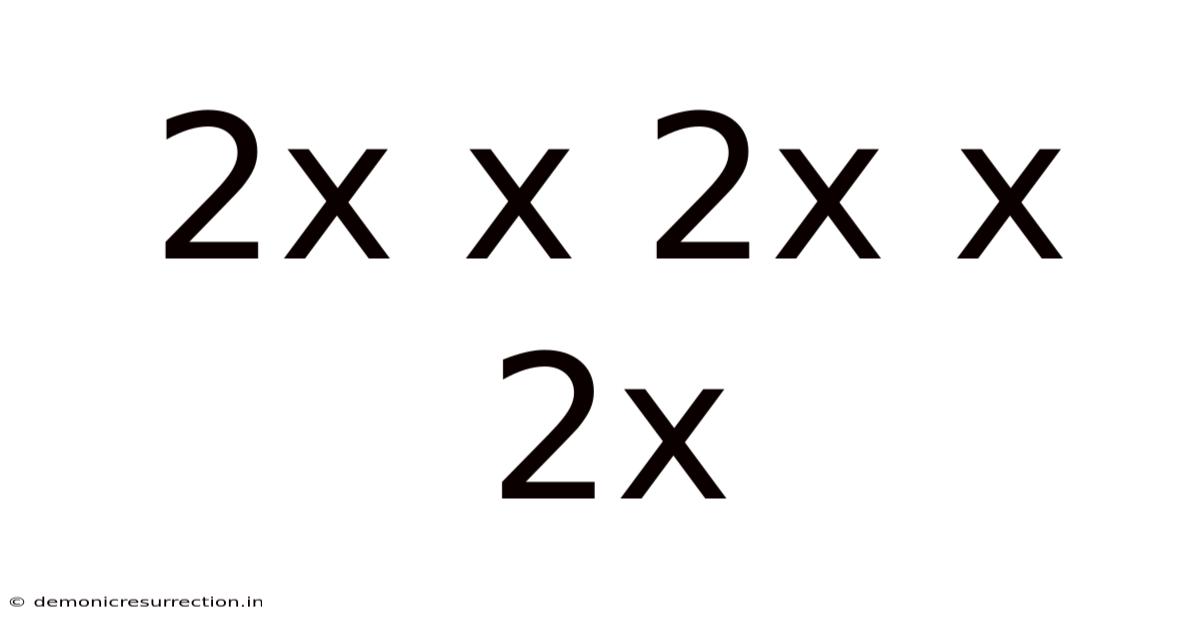
Decoding 2x x 2x x 2x: An Exploration of Exponential Growth and its Real-World Applications
This article breaks down the fascinating world of exponential growth, represented mathematically by the expression 2x x 2x x 2x, or more concisely, (2x)³. In practice, we'll explore its mathematical foundations, practical applications across various fields, and its implications for understanding complex phenomena. On top of that, understanding exponential growth is crucial in various disciplines, from finance and biology to technology and social sciences. This exploration will illuminate its significance and equip you with a deeper understanding of this powerful concept.
Understanding the Basics: Exponents and Multiplication
Before diving into the intricacies of (2x)³, let's refresh our understanding of exponents and multiplication. An exponent, also known as a power or index, indicates how many times a number (the base) is multiplied by itself. To give you an idea, 2³ means 2 x 2 x 2 = 8. The expression 2x signifies that the variable 'x' is multiplied by 2 Most people skip this — try not to. That alone is useful..
So, (2x)³ means (2x) x (2x) x (2x). In real terms, this is not simply 2³ x x³ (a common mistake! ), but rather a repeated multiplication involving both the constant (2) and the variable (x).
(2x)³ = (2x) x (2x) x (2x) = 2 x 2 x 2 x x x x = 8x³
This clarifies that the exponent applies to both the coefficient (2) and the variable (x), resulting in 8x³. Understanding this fundamental principle is crucial for further exploration.
Expanding the Expression: Different Perspectives
While the simplified form 8x³ is sufficient for many applications, let's examine different approaches to understanding the expression (2x)³. This multifaceted approach reveals the underlying structure and its adaptability in diverse contexts.
-
Distributive Property: While not directly applicable in this simplified case, understanding the distributive property is essential when dealing with more complex expressions. Consider (2x + 1)³. Here, the distributive property would be used to expand the expression.
-
Binomial Theorem: For higher powers of binomial expressions (expressions with two terms), such as (2x + 1)³, the binomial theorem provides a systematic method for expansion. This theorem greatly simplifies the process of expanding expressions with higher exponents.
-
Geometric Interpretation: Visualizing exponential growth is invaluable. Imagine a square with sides of length 2x. Its area would be (2x)². Now, imagine a cube with sides of length 2x. Its volume would be (2x)³. This geometric perspective offers a tangible representation of the expression's meaning And it works..
-
Real-world Analogy: Consider a scenario where you invest an initial amount of 'x' dollars, and it doubles every year. After three years, your investment will be (2x)³. This provides a practical context for understanding the growth represented by the expression Simple as that..
Applications of Exponential Growth: Real-World Examples
The principle encapsulated in (2x)³ – exponential growth – permeates numerous fields. Let’s explore some key examples:
-
Compound Interest: In finance, compound interest represents exponential growth. If you invest a principal amount 'x', and it earns interest at a rate that compounds (adds interest to the principal), your investment will grow exponentially over time. The formula for compound interest incorporates exponential growth directly.
-
Population Growth: Under ideal conditions, populations (biological or otherwise) can exhibit exponential growth. If a population doubles in size every generation (represented by 'x'), after three generations, the population size would be (2x)³. Factors like resource limitations and environmental pressures often limit this growth in the long run, however the initial phases of growth frequently demonstrate an exponential pattern.
-
Technological Advancement: Moore's Law, which posits that the number of transistors on a microchip doubles approximately every two years, is a prime example of exponential growth in technology. This has driven remarkable advancements in computing power over the past decades, illustrating the transformative potential of exponential growth.
-
Viral Spread: The spread of infectious diseases or viral trends online can be modelled using exponential growth, initially. The rate of spread often slows down as the pool of susceptible individuals shrinks. Even so, in the early stages, exponential growth accurately captures the rapid expansion of the infection or trend Most people skip this — try not to. No workaround needed..
-
Radioactive Decay (Inverse Exponential): While (2x)³ represents growth, it’s important to note that many processes exhibit exponential decay. Radioactive decay is a classic example. The amount of a radioactive substance decreases by a constant factor over a specific time period. While the mathematics differ slightly, the concept of exponential change remains central.
-
Financial Bubbles: Speculative bubbles in financial markets often exhibit exponential growth in the early stages. As more investors jump on the bandwagon, prices escalate rapidly, leading to unsustainable growth that eventually collapses. This demonstrates the precarious nature of unchecked exponential growth.
Mathematical Analysis: Beyond (2x)³
The expression (2x)³ offers a simple illustration of exponential growth, but the concepts extend to much more complex scenarios. Consider the general form of exponential growth:
y = a * bˣ
Where:
- y is the final value
- a is the initial value
- b is the growth factor (in our example, 2)
- x is the number of periods (in our example, 3)
This general formula allows us to model a vast range of exponential growth processes, incorporating different initial values, growth factors, and time periods. Understanding this general form provides a much broader perspective on exponential growth.
Limitations and Considerations
It's crucial to acknowledge that exponential growth rarely continues indefinitely in real-world scenarios. Various limiting factors, such as resource scarcity, environmental constraints, and competitive pressures, often constrain exponential growth, leading to a slowdown or plateauing of the growth rate. Logistic growth models, for example, better represent growth that eventually levels off due to these constraints.
Frequently Asked Questions (FAQ)
-
Q: What happens if x is negative in (2x)³?
- A: If x is negative, the result will also be negative, but the magnitude will still follow the exponential pattern. To give you an idea, if x = -1, (2x)³ = -8.
-
Q: Can (2x)³ be expressed differently?
- A: Yes, as previously stated, it simplifies to 8x³.
-
Q: What if the base was a number other than 2?
- A: The principle remains the same. (3x)³ would expand to 27x³. The key is that the exponent applies to both the coefficient and the variable.
-
Q: How is exponential growth different from linear growth?
- A: Linear growth increases at a constant rate, while exponential growth increases at a constant percentage rate. Linear growth is represented by a straight line on a graph, while exponential growth is represented by a curve that gets steeper over time.
-
Q: What are some tools or software that can help model exponential growth?
- A: Spreadsheet software (like Microsoft Excel or Google Sheets) and mathematical software (like MATLAB or R) are commonly used to model and visualize exponential growth. These tools provide powerful tools for data analysis and simulation.
Conclusion: The Power of Exponential Growth
The seemingly simple expression (2x)³ unlocks a deep understanding of exponential growth, a fundamental concept with far-reaching implications. From financial markets to biological systems, exponential growth shapes our world in profound ways. While understanding its mathematical basis is essential, appreciating its real-world applications and limitations is equally important. By grasping the nuances of exponential growth, we gain a more insightful and comprehensive understanding of the complex systems that surround us. Its power lies not only in its mathematical elegance, but also in its ability to describe and predict dynamic changes across various aspects of our world Turns out it matters..
