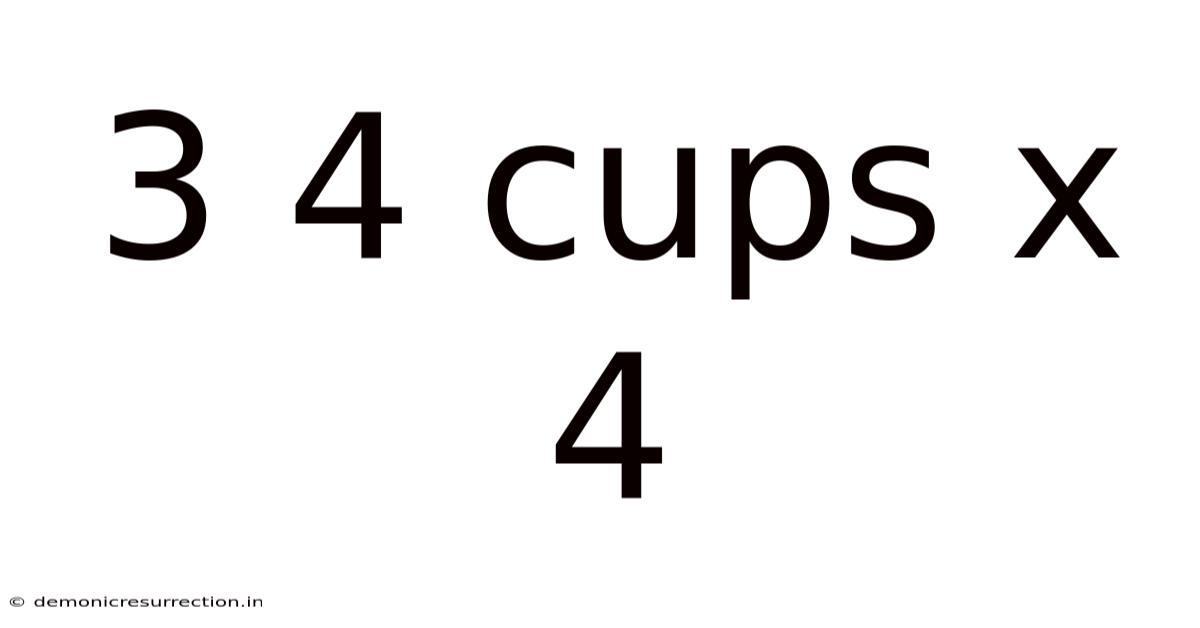
Decoding 3, 4 Cups x 4: Exploring the Math, Science, and Practical Applications
This article walks through the seemingly simple mathematical expression "3, 4 cups x 4," exploring its various interpretations, practical applications across different fields, and the underlying principles of multiplication and measurement. We will uncover how this seemingly basic calculation touches upon concepts ranging from simple arithmetic to advanced statistical analysis, making it a surprisingly rich topic for exploration. Understanding this seemingly simple equation opens doors to a deeper understanding of mathematics and its real-world relevance Simple as that..
Understanding the Basics: Multiplication and Units
At its core, "3, 4 cups x 4" represents a multiplication problem. Let's break it down:
-
3, 4 cups: This signifies a quantity of 3.4 cups. The comma is used as a decimal separator, representing 3 and 4 tenths of a cup.
-
x 4: This indicates we are multiplying the quantity of 3.4 cups by 4.
Because of this, the core mathematical operation is 3.And 4 * 4. This is a fundamental multiplication problem that can be solved using various methods, from basic arithmetic to calculators Easy to understand, harder to ignore..
Solving the Equation: Different Approaches
There are several ways to solve 3.4 x 4:
- Standard Multiplication: We can perform long multiplication:
   3.4
x    4
------
  13.6
- Distributive Property: We can break down 3.4 into 3 + 0.4 and apply the distributive property:
(3 + 0.4 x 4) = 12 + 1.4) x 4 = (3 x 4) + (0.6 = 13 Nothing fancy..
- Using a Calculator: The simplest method is to use a calculator, which directly provides the answer: 13.6
The solution to 3.4 cups x 4 is 13.6 cups.
Practical Applications: From Cooking to Chemistry
The seemingly simple calculation of 3.4 cups x 4 has surprisingly wide-ranging applications in various fields:
-
Cooking and Baking: Recipes often require precise measurements. If a recipe calls for 3.4 cups of flour and you need to quadruple the recipe, you'll need 13.6 cups of flour. This highlights the importance of accurate measurement in culinary arts. Understanding fractions and decimal conversions is crucial for successful baking and cooking That's the part that actually makes a difference..
-
Chemistry and Science: In chemistry and other scientific disciplines, precise measurements are essential. If a chemical experiment requires 3.4 milliliters of a solution and the experiment needs to be repeated four times, the total volume required would be 13.6 milliliters. This calculation ensures the experiment's accuracy and reproducibility. Similar calculations are crucial in physics, engineering, and other scientific fields dealing with quantities and measurements.
-
Construction and Engineering: In construction and engineering projects, accurate measurements are essential for creating structurally sound buildings and other infrastructure. Calculations involving volumes, materials, and proportions often involve multiplications similar to this example. Imagine calculating the amount of concrete needed for a foundation – such calculations often involve decimal numbers and multiplications.
-
Business and Finance: Scaling up production, calculating costs, or determining profit margins often involve multiplying quantities by a certain factor. Understanding such calculations is vital for sound financial decision-making.
-
Data Analysis and Statistics: In data analysis and statistics, multiplying quantities is a common operation used in various calculations, including scaling data, calculating averages, and performing statistical tests. The understanding of decimal numbers and accurate calculations is crucial for the validity and reliability of statistical analysis Small thing, real impact..
Beyond the Basics: Understanding Measurement and Error
While the mathematical operation is straightforward, the practical application of "3, 4 cups x 4" highlights the importance of considering measurement accuracy and potential errors.
-
Measurement Units: The units involved are crucial. We're dealing with "cups," a unit of volume. Understanding the specific type of cup (e.g., a standard measuring cup) is essential for consistency and accuracy. Inconsistencies in cup sizes can lead to significant errors in the final result.
-
Significant Figures: In scientific and engineering contexts, the concept of significant figures dictates the precision of the final answer. If the initial measurement of 3.4 cups has only two significant figures, the final answer (13.6 cups) should also be reported with two significant figures.
-
Error Propagation: Even small errors in the initial measurement can propagate and lead to larger errors in the final result. Understanding the potential sources of error and their impact on the final outcome is crucial for reliable measurements and calculations.
Frequently Asked Questions (FAQ)
Q: What if the recipe calls for 3 1/4 cups instead of 3.4 cups?
A: 3 1/4 cups is equivalent to 3.25 by 4 gives you 13 cups. But 25 cups. Practically speaking, multiplying 3. This demonstrates the importance of correctly converting fractions to decimals (or vice versa) for accurate calculations.
Q: Can this calculation be applied to other units of measurement?
A: Absolutely! This principle of multiplication applies to any unit of measurement—liters, milliliters, grams, kilograms, etc. The underlying mathematical principle remains the same, but the units of the final answer will reflect the units of the initial measurement That's the part that actually makes a difference..
Q: What are some common mistakes to avoid when performing this type of calculation?
A: Common mistakes include:
- Incorrectly converting fractions to decimals.
- Errors in basic multiplication.
- Ignoring significant figures or measurement errors.
- Not paying attention to the units of measurement.
Q: How can I improve my accuracy in performing these types of calculations?
A: Practice is key. Because of that, regularly solve similar problems, using different methods to improve your understanding and accuracy. So using a calculator for complex calculations can help reduce the risk of errors. Also, understanding significant figures and error propagation will ensure more accurate results in scientific and engineering applications Simple as that..
Conclusion: The Unexpected Depth of a Simple Equation
The seemingly simple calculation of "3, 4 cups x 4" opens a window into the world of mathematics, measurement, and its vast applications across numerous fields. This seemingly simple calculation highlights the importance of attention to detail, understanding of measurement units, and the principles of multiplication and error propagation. From precise baking recipes to complex scientific experiments, the ability to accurately perform this type of calculation is essential. By understanding the fundamental concepts and potential pitfalls, we can use this basic skill to solve more complex problems and make more accurate calculations across various disciplines. The depth of understanding gained extends far beyond the simple arithmetic, laying a crucial foundation for more advanced concepts and applications in science, engineering, and everyday life Worth knowing..
