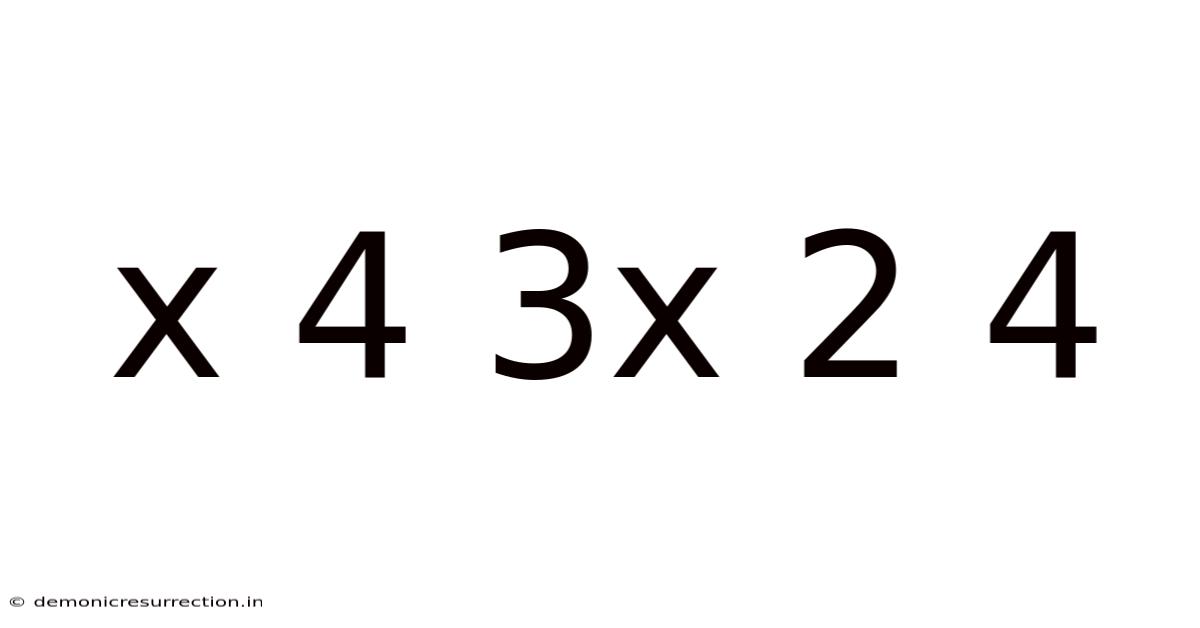
Decoding the Mystery: Exploring the Mathematical Sequence x 4 3x 2 4
This article looks at the intriguing mathematical sequence represented as "x 4 3x 2 4." We will unpack its potential meanings, explore possible interpretations, and analyze its structure to uncover the underlying logic. Understanding this sequence requires considering various mathematical concepts, including arithmetic progressions, geometric progressions, and potentially even more complex patterns. So we will examine each possibility, providing detailed explanations and illustrative examples. This exploration will not only decipher the sequence but also enhance your understanding of fundamental mathematical principles.
Understanding the Problem: Defining the Variables
The core of the problem lies in the ambiguous nature of the representation "x 4 3x 2 4". The numbers interspersed with 'x' are constant values, presenting a challenge in determining how they relate to the variable 'x' and to each other. Plus, the use of 'x' immediately suggests a variable, implying the existence of an underlying pattern or formula. It's crucial to approach this problem systematically, exploring various possibilities and testing their validity.
Approach 1: Arithmetic Progressions
One possible approach is to consider the sequence as an arithmetic progression. An arithmetic progression is a sequence where the difference between consecutive terms remains constant. Even so, applying this method directly to the sequence "x 4 3x 2 4" is problematic. The presence of the variable 'x' makes it difficult to find a consistent common difference.
- Scenario: If we assume the sequence is an arithmetic progression and 'x' represents a specific numerical value, then we would attempt to find a common difference between the terms. Still, this method fails to yield a consistent difference without assigning an arbitrary value to 'x'. Take this case: if x = 1, the sequence becomes 1 4 3 2 4. The differences between consecutive terms are 3, -1, -1, 2. There is no constant difference.
That's why, a simple arithmetic progression is unlikely to be the solution Easy to understand, harder to ignore..
Approach 2: Geometric Progressions
Another possible mathematical interpretation is a geometric progression. A geometric progression is a sequence where each term is the product of the previous term and a constant value (the common ratio). Let's analyze the sequence using this approach:
- Scenario: If we consider 'x', 4, '3x', 2, and 4 as terms in a geometric progression, we quickly encounter inconsistencies. Finding a common ratio that links all these terms, including the variable 'x', proves impossible. The inclusion of 'x' complicates the application of a constant ratio.
Hence, a geometric progression also fails to provide a consistent interpretation of the given sequence.
Approach 3: Polynomial Equations
A more sophisticated approach involves considering the possibility of a polynomial equation. Which means a polynomial equation is an equation involving variables raised to non-negative integer powers. The complexity here stems from the inclusion of both a variable ('x') and numerical constants. To attempt to solve this as a polynomial would require assuming the nature of the polynomial (e.Even so, g. , is it a quadratic, cubic, or higher-order polynomial).
- Scenario: Let's hypothetically assume a simple quadratic equation of the form: ax² + bx + c. We would need at least three data points to solve for the unknowns a, b, and c. The given sequence only provides five elements, but the relationship between these elements isn’t immediately clear. Without additional information or constraints, this approach remains inconclusive. More complex polynomial equations are possible, but without additional information, attempting to fit this sequence to a polynomial is speculative.
Approach 4: Piecewise Functions
The sequence might also be represented by a piecewise function. Worth adding: a piecewise function is defined by different sub-functions over different intervals of the domain. It's possible that the sequence is generated by different rules applied to different parts of the sequence No workaround needed..
- Scenario: This approach requires a greater degree of speculation. One could imagine a scenario where ‘x’ plays a role in determining which sub-function is used at different points in the sequence. Without further context or data points, forming a conclusive piecewise function is impractical.
Approach 5: Recursive Relationships
Another avenue to explore is the possibility of a recursive relationship. A recursive relationship defines a term in a sequence based on one or more preceding terms. This type of relationship requires identifying a pattern linking consecutive elements Worth knowing..
- Scenario: Let's examine whether a recursive pattern exists. Could one term be expressed as a function of another? Let's explore this hypothetically: The presence of 'x' and the varying numerical values make it challenging to establish a consistent recursive relationship. Without sufficient data or constraints, the identification of such a relationship remains purely speculative.
Approach 6: Coded Sequence or Encryption
A more abstract approach involves considering the possibility of the sequence representing a code or encrypted message. The presence of 'x' might represent an unknown element or a placeholder within a broader code system. This possibility moves beyond purely mathematical analysis and into the realm of cryptography or code-breaking techniques Took long enough..
- Scenario: If this were a coded sequence, a cryptanalysis approach would be necessary. This would involve looking for patterns, repetitions, or clues that might reveal the underlying system used to generate the sequence. Even so, without additional context or information, it's impossible to definitively determine whether this sequence represents a code or cipher.
Conclusion: The Ambiguity of "x 4 3x 2 4"
The sequence "x 4 3x 2 4" presents a fascinating puzzle with no single definitive solution. The presence of the variable 'x' introduces ambiguity, preventing the straightforward application of common mathematical progression concepts. While we explored several potential interpretations, including arithmetic and geometric progressions, polynomial equations, piecewise functions, recursive relationships, and even the possibility of a hidden code, none yielded a conclusive result. The lack of additional information or context makes it impossible to determine the intended pattern with certainty. Think about it: to find a solution, we'd require additional information specifying the relationship between the variable 'x' and the numerical constants or the context from which this sequence originates. The sequence remains an intriguing challenge, highlighting the limitations of applying mathematical principles without sufficient data or constraints That's the part that actually makes a difference..
Further Exploration: Expanding the Possibilities
The ambiguity of the sequence opens up avenues for further exploration. Here are some avenues to consider:
- Additional Data: The introduction of more elements within the sequence could reveal patterns not immediately apparent in the limited data provided.
- Contextual Information: Understanding the context in which this sequence was presented would be crucial in determining its intended meaning. Was it part of a larger mathematical problem? Did it arise in a specific field of study?
- Alternative Interpretations: We focused primarily on numerical interpretations. That said, it is possible that 'x' and the numbers represent symbols with a different meaning entirely, making a symbolic or logical interpretation necessary.
This exploration serves as a reminder that the application of mathematical principles requires both rigorous analysis and a keen understanding of context. The absence of either can lead to ambiguity and a multitude of possible solutions, as demonstrated by the challenge of deciphering "x 4 3x 2 4".
